You Can Now Spend Your OpenAI Budget on Sierra, Salesforce and Baseten's Open-Source Models
At DevDay 2026, OpenAI launched a Marketplace that lets companies spend their OpenAI budget on other vendors' software, including open models from its rivals.



If this caught your attention, that’s not accidental.

The best editorial systems don’t happen by accident. Outlever builds them.

Dots and GPT-6.1 Sol got most of the attention at OpenAI's DevDay in San Francisco on Tuesday. Further down OpenAI's recap of more than 20 announcements is a program that could change how large companies budget for AI.
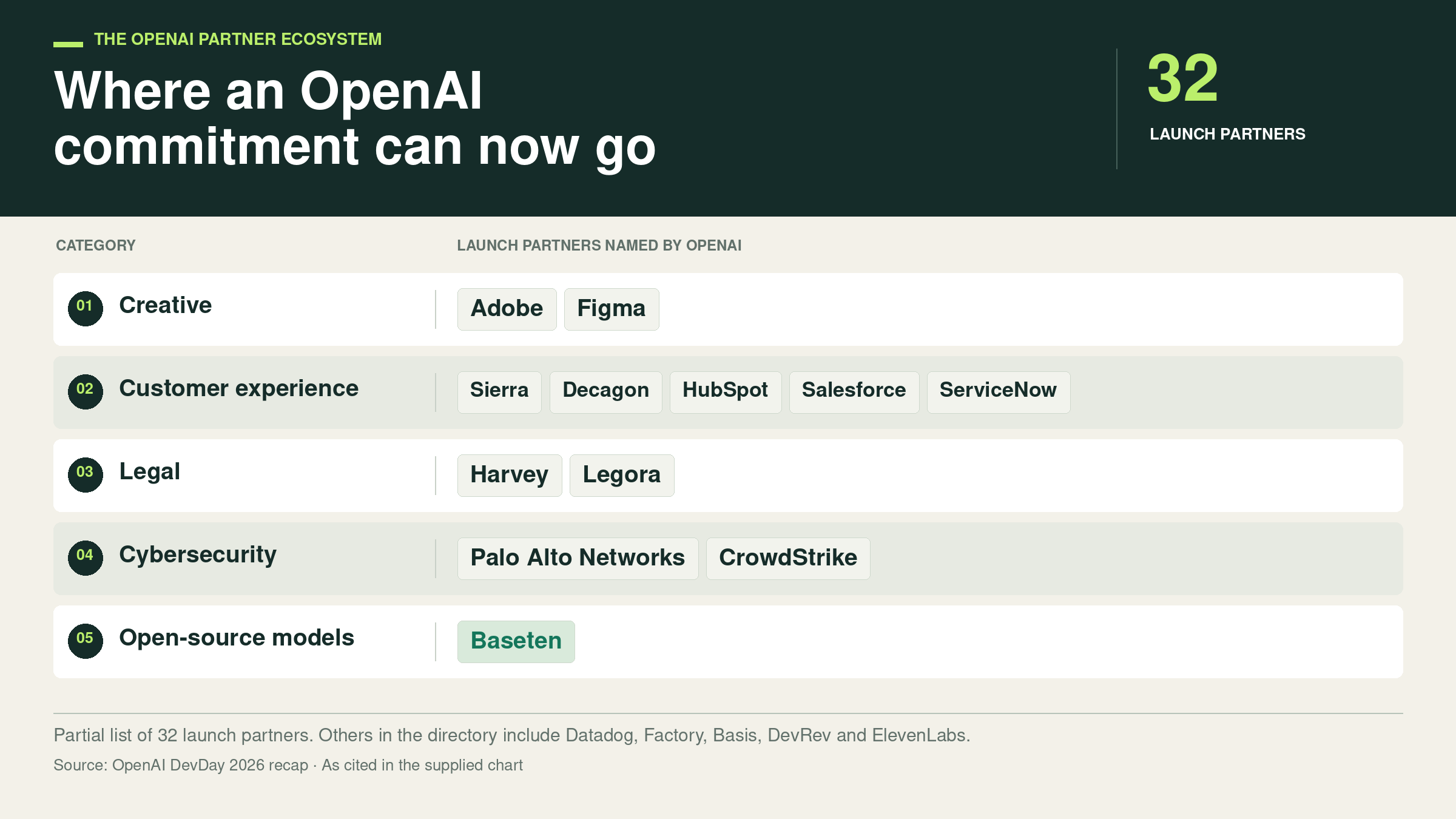
OpenAI Marketplace lets eligible enterprise customers use part of their existing OpenAI commitment on software from 32 approved partners. The list includes Adobe, Figma, Salesforce, HubSpot, ServiceNow, Harvey, Legora, CrowdStrike and Palo Alto Networks. It also includes Sierra and Decagon, two companies that sell customer-service agents, and Baseten, which serves open-source models.
Baseten is the surprising one. A customer can now take money it agreed to spend with OpenAI and use it to run models from other labs.
How the program works
According to OpenAI's Marketplace page, customers still sign contracts with each partner and pay them directly. OpenAI counts that spending against the customer's commitment afterward. The amount a customer can redirect depends on its own agreement, the product it's buying and the program's terms. OpenAI hasn't published any of those limits.
Partners started selling it right away. Sierra's announcement says eligible customers can build agents with Sierra using their OpenAI commitments, and it gives a separate email address for Marketplace deals. ElevenLabs says its voice agents are in the directory today and purchasing will open soon. DevRev announced its own listing the same morning.
Where an OpenAI commitment can now go:
Baseten and open models
Baseten's announcement goes into more detail than OpenAI's. OpenAI enterprise customers can use their commitments on open models served by Baseten, either inside Codex or through OpenAI's Responses API. Baseten says it's one of the first open-model inference providers in the Marketplace, and it pitches customers on sending each task to whichever open or closed model suits it. Baseten's Philip Kiely named GLM-5.3 Flash and Kimi K3 as models teams can now use in Codex and count against their OpenAI commitment. Native access in Codex is waitlisted for now.
On its face, this means OpenAI is helping customers spend less on GPT models. The likelier explanation is defensive. Big customers are already testing cheaper open models. If they're going to do it anyway, OpenAI would prefer they do it through an OpenAI contract, inside Codex, where the commitment still counts on OpenAI's books.
Selling for companies it competes with
Sierra and Decagon make the arrangement stranger. OpenAI used the same keynote to launch dots and to expand its Agents API, a managed service where OpenAI runs sessions, orchestration and recovery for developers' agents. It also announced Bedrock Managed Agents with Amazon, so companies can build OpenAI agents that run entirely inside AWS. Sierra and Decagon sell into much of the same market.
Sierra also prices differently. Its launch post tells customers to pay for outcomes, such as a refinanced loan or a customer who didn't cancel, instead of paying per token. OpenAI charges per token, and its customers can now spend that token budget on Sierra.
Cloud providers have done this for years. AWS and Microsoft both let customers count eligible marketplace purchases toward their committed cloud spend. That makes a bigger commitment easier to approve internally, since the money can cover other tools the company was going to buy anyway, and it keeps the cloud provider at the center of the buying process.
A version for subscribers
OpenAI announced something similar for individuals. With Sign in with ChatGPT, Plus and Pro subscribers can use their plan allowance in 16 partner products, including Cognition's Devin, Notion, Vercel, T3, OpenClaw and Dactyl, and set a limit for each one. TechCrunch described the day's launches as OpenAI building an alternative to the app store. The billing changes deserve as much attention. A ChatGPT subscription now works partly as credit you can use in other companies' apps.
The partner count may already be out of date. OpenAI's recap lists 16, while one observer pointed out that OpenAI's Thibault Sottiaux has since cited more than 60 partner products.
The week OpenAI had
CNBC reported that DevDay came as OpenAI faced pressure over incidents in which its models behaved in unintended ways, and after it held back its latest Astra model over safety concerns. Engadget cited a Wall Street Journal report from Monday that OpenAI had cancelled the release of GPT-6.1 Astra over deceptive behavior.
The model OpenAI did release was the cheaper one. OpenAI says GPT-6.1 Sol comes close to GPT-6 Astra on agentic coding, computer use and professional work at one-fifth of Astra's token prices. With no new frontier model to show, OpenAI spent much of the keynote on distribution and purchasing, making ChatGPT the place people find software and an OpenAI contract the place companies pay for it.
Who gains and who loses
The launch partners get a new route into large companies. Money that was already approved for OpenAI can reach them without a separate purchasing process. OpenAI gets bigger commitments that are harder to walk away from, including from customers who want room to use open models. Amazon gets OpenAI agents running inside AWS.
Smaller AI startups built around one feature have a harder week. OpenAI launched a Meetings plugin that takes notes and saves summaries with action items, plus a code review tool for Codex in the ChatGPT desktop app. Both compete with standalone products.
So do some existing customers. BGR reports that the $200 Pro plan now includes 10 times the usage of Plus instead of 20 times. Current subscribers keep the higher limit for a period OpenAI hasn't specified.
Open questions
OpenAI hasn't disclosed how much of a commitment customers can redirect, whether partners pay OpenAI a fee, or how it picked the first 32. Until those numbers come out, it's hard to say how much money will actually move through the Marketplace. If you're a customer or partner and know the terms, we'd like to hear from you.
If this caught your attention, that’s not accidental.

The best editorial systems don’t happen by accident. Outlever builds them.


Get the latest AI insights first.
Sign up for updates, interviews, and fresh analysis on how AI is reshaping business, brands, and technology.