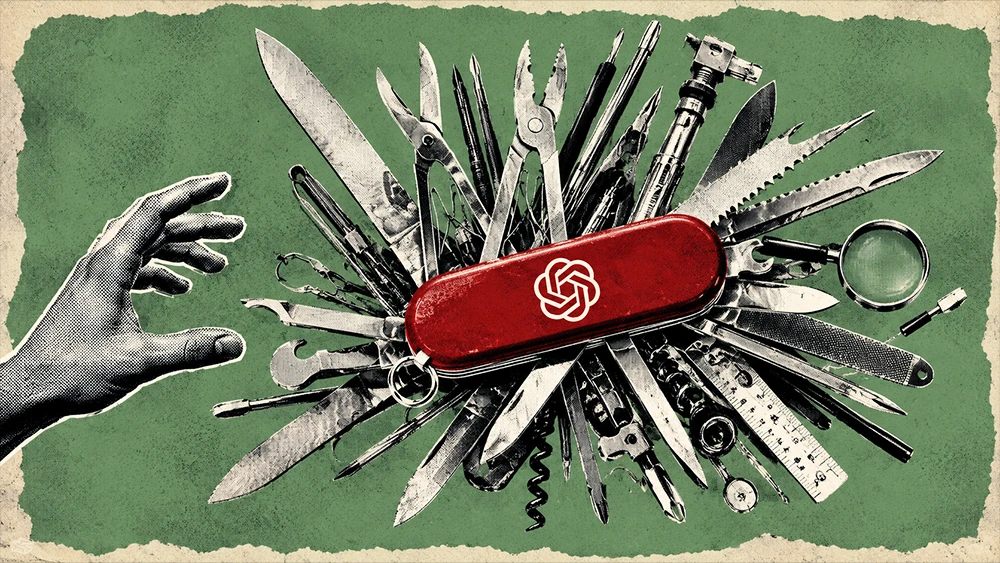
OpenAI wants to rebuild ChatGPT into a "superapp." That is the weekend's news, sourced to the Financial Times and relayed by Reuters, Fortune, and most of the financial press. The plan, as reported, is the biggest overhaul of ChatGPT since the chatbot launched in 2022: a redesigned web and mobile interface that pushes users toward coding, image generation, autonomous agents, and partner apps from companies including Canva and Booking.com. OpenAI's coding product, Codex, moves to the center. The Information reported on June 3 that Codex and ChatGPT will effectively be fused. The stated motive is a shift toward higher-margin enterprise customers, sourced to more than a dozen current and former employees. OpenAI has not commented, and Reuters said it could not independently verify the account.
Read the product details and you get one story. Read the calendar and you get a more useful one.
This did not arrive in a vacuum. It arrived about two weeks after OpenAI confidentially filed its draft IPO paperwork with the SEC, with Goldman Sachs and Morgan Stanley leading and a listing window targeted between September and November 2026. And it arrived less than a week after Anthropic filed its own confidential paperwork, beating OpenAI to the punch. The timing is the part worth paying attention to.
The number OpenAI has to justify
Consider what public-market investors will be handed. OpenAI's last private valuation was about $852 billion, set in a $122 billion round in March backed by Amazon, Nvidia, and SoftBank. Reporting puts the IPO ambition above $1 trillion, which would make it the largest listing in history. Against that sits a business reportedly running around $25 billion in annualized revenue and, by several accounts, losing roughly $1.22 for every dollar it earns. At the low end of the valuation range that works out to about 34 times revenue, and above 40 times at the high end. Meta went public at roughly 8 times sales.
A multiple like that is hard to support with a popular chatbot, even one with 900 million weekly users and more than 50 million subscribers. Consumer subscriptions carry thin margins and high churn, and public markets have spent two years growing wary of AI cash burn. What supports a multiple like that is a platform story: durable enterprise revenue, software that executes work instead of just discussing it, and an ecosystem customers find hard to leave. The superapp redesign is the clearest possible expression of that story. It is the roadshow slide that says OpenAI is no longer a chatbot company.
So the product changes are real, but the urgency behind them is financial. This is a narrative being sharpened for bankers and institutional buyers, then presented to everyone else as a product breakthrough.
OpenAI is moving onto Anthropic's ground
The move also looks more defensive than visionary once you notice where OpenAI is headed. The territory it is rushing toward, enterprise revenue and coding above all, is exactly where Anthropic has been winning.
Anthropic filed confidentially on June 1 at a $965 billion valuation, having just closed a $65 billion round that pushed it past OpenAI's private mark for the first time. Its reported revenue run rate has climbed to around $47 billion, up from roughly $10 billion a year earlier, driven heavily by enterprise and developer adoption of Claude and Claude Code. Wedbush analyst Dan Ives called the filing a major step for Anthropic to get ahead of OpenAI, and the appearance of OpenAI's superapp plans days later is hard to read as coincidence.
Put plainly, the subtext of putting Codex at the center of ChatGPT is that OpenAI cannot afford to let the coding and enterprise story belong to Anthropic going into these listings. That is a sensible competitive response. It is not the same thing as a confident product vision the company arrived at on its own, and investors who have been watching closely will see the difference.
Superapps have a poor record in the West
Even if the strategy makes sense, the vehicle has a leaky history. The superapp everyone points to is WeChat, and it succeeded under conditions the West does not share: a mobile-first population that skipped cards for in-app payments, a regulatory climate comfortable with data concentration, and one dominant messaging surface to attach everything to. Forrester declared the superapp window closed for Western markets back in 2023, arguing that iOS and Android already deliver most of what a superapp would. X's "everything app" ambitions are the cautionary tale closest to home.
The strategy analyst Sangeet Paul Choudary has made a sharper point about these efforts. You do not become a superapp by stuffing services behind one interface. You become one by being the interface people actually choose for those services. Dropping Canva and Booking.com tiles into ChatGPT does not by itself make ChatGPT the place people go to design or book a trip. It risks the opposite outcome, a cluttered surface where every new capability becomes another button, partner tile, or upsell, eroding the clean utility that made the product popular to begin with.
There is also the most ambitious claim buried in the reporting, that OpenAI eventually wants to phase out prompts entirely and let its models infer what users want without being asked. As a research goal, that is reasonable. As something propping up a trillion-dollar valuation, it places enormous weight on a capability that does not reliably exist yet. Agents that book, code, schedule, and transact need far more access to user and business context, which puts privacy, permissions, audit trails, and enterprise controls on the critical path, in the Western regulatory environment least friendly to data concentration.
What we will be watching
None of this guarantees the redesign fails. A genuinely useful, agent-driven ChatGPT could deepen engagement and convert more of those 900 million weekly users into paying enterprise seats, and OpenAI has beaten skeptics before.
Two things are worth keeping in view as this plays out. The superapp pivot is best understood as an IPO instrument, an effort to convert a consumer-chatbot story into the platform-and-enterprise story a $1 trillion price tag demands, before the prospectus goes public and the first audited financials force the question. It is also a chase. OpenAI is moving onto the coding and enterprise ground where Anthropic, fresh off passing it in both valuation and filing order, has been setting the pace.
The real test is not the redesign that ships in the coming weeks. It is whether, when both companies' numbers finally reach the public record this fall, the platform narrative holds up against the financials, or turns out to be the most flattering way to describe a very expensive race.