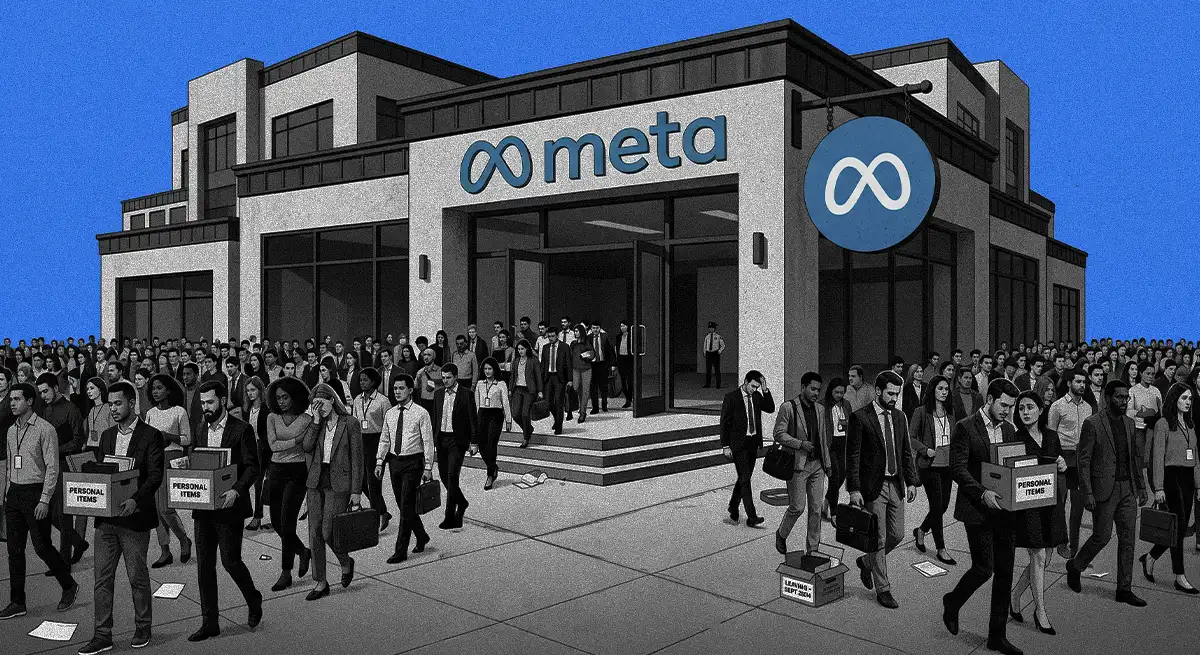
This week Meta announced America's Workforce Academy, a $115 million program to train welders, electricians, fiber technicians, and HVAC installers free of charge, with a guaranteed job at the end. Graduates get paid while they train. Their airfare and housing are covered. They walk out with a portable credential and a job offer on a Meta data center construction site. By Meta's own description, it is the largest private-sector commitment to the skilled trades with a job guarantee in U.S. history.
It is also, on its face, a strange thing for Meta to be doing three weeks after cutting roughly 8,000 white-collar workers.
Most outlets reached for the obvious angle. Meta builds software, it just fired a bunch of the people who do that, and now it's paying to train people who pour concrete. Knowledge work is out, trade work is in, and the welders had the last laugh on the laptop class. It's a satisfying narrative because it speaks to an anxiety we've all been marinating in for a couple of years now, that AI is finally turning the tables on the people who spent two decades being told to learn to code.
That read is wrong, or at least shallow. The more honest and more unsettling story is that the layoffs and the trade school are not opposites. They are the same move.
Follow the number
The Workforce Academy costs $115 million. Meta's 2026 capital expenditure guidance, the spending that caused the layoffs in the first place, runs between $115 and $135 billion. The symmetry is almost too neat. The trade school is one one-thousandth of the infrastructure bet it exists to serve.
Meta did not cut 8,000 jobs because it was in trouble, It cut them because it is spending more money than almost any company in history on data centers, GPUs, and power, and it needs to protect its operating margins while doing so. The white-collar reductions and the blue-collar recruitment drive are both line items in the same ledger, both pointed at the same object, which is the physical buildout of AI.
The knowledge workers were not replaced by electricians. They and the electricians are both being reorganized around the data center. One group got smaller to free up capital. The other group is being manufactured because it doesn't exist yet in the numbers Meta needs. The collar color is a distraction. The throughline is the concrete.
"Jobs that didn't exist five years ago"
Meta's own language gives the game away, if you read it less as inspiration and more as strategy. The company describes the academy as creating real opportunity, no college debt, getting paid to train for jobs that didn't exist five years ago and will define the next twenty. Mark Zuckerberg framed it as a response to a national shortage. America needs hundreds of thousands of tradespeople, and the training pipeline hasn't kept up as older workers retire.
All of that is true. There is a genuine, well-documented shortage of skilled trades labor, and the AI infrastructure boom has made it acute. You cannot build a gigawatt-scale data center campus in Louisiana without electricians and fiber techs, and there simply aren't enough of them. Meta's $27 billion joint venture for that single Louisiana campus is bottlenecked not by chips or capital but by people who can wire a building.
So the academy is, in the most literal sense, a supply-chain fix. Meta found a critical input in short supply and decided to manufacture it in-house rather than wait for the labor market to deliver. That's the same logic that leads a company to build its own chips or sign its own power deals. The novelty is that the scarce input is human labor and the factory is a school.
This reframes what investing in workers means here. Meta is not betting on the skilled trades as a social good, or hedging against an AI future, or making a statement about the dignity of physical work. It is procuring a resource. The guaranteed job is not generosity. It is the whole point. Meta needs the graduate on its construction site, so it removes every obstacle between the applicant and the job site, including the cost of training and the risk of unemployment. You provide a guaranteed job offer when you are the one who's desperate.
The asymmetry that should worry us
Both of these labor pools serve the data center, but they serve it in very different ways.
The construction labor is needed now, intensely, and temporarily. Building a data center is a surge. You need thousands of trades workers for the duration of the build and far fewer to run it once the lights are on. The academy is explicit that graduates are hired by contractors to work on construction sites. These are real jobs with real credentials that travel across employers, which is to Meta's credit. But they are tied to a buildout phase, and buildout phases end. The portable credential is a feature precisely because the Meta-specific work is finite.
The white-collar labor is being cut because Meta believes, and is betting $135 billion, that much of what those workers did can increasingly be done by the systems the data centers will run. Meta's own internal Model Capability Initiative is described as an effort to train AI to perform coding and white-collar tasks. The layoffs aren't just cost discipline. They are a forward bet that the knowledge work is becoming automatable, and the infrastructure being built by the trade-school graduates is what will automate it.
Put those two facts together and the irony inverts. The tradespeople are not the winners of the AI era. They are the ones building the thing designed to make a lot of human labor, eventually including some categories of skilled work, less necessary. They are constructing the engine of the same automation logic that just eliminated 8,000 of their white-collar counterparts. The data center does not care what collar you wear. It needs hands to build it, and then it needs far fewer of anyone.
What it really says
What this actually tells us is that the AI buildout is now large enough to reshape labor markets in two directions at once, shedding workers a company has decided are surplus while scrambling to mint workers it cannot find. The same company, in the same fiscal year, with budgets denominated in the same units, is doing both.
It tells us that "AI is coming for white-collar jobs" is too small a frame and that AI is reorganizing all work around the infrastructure it requires. Some of that work it suppresses, some it summons into existence, and the deciding factor is not whether a job is cognitive or physical. It is whether the job sits upstream or downstream of the machine. Upstream of the data center, building it, powering it, wiring it, labor is suddenly precious. Downstream of it, doing the tasks the models will run, labor is suddenly negotiable.
It also tells us something about how these companies will manage the politics of the transition. There is a reason Meta wrapped a labor-procurement strategy in the language of American heroes, debt-free opportunity, and building the future. A company laying off thousands while spending hundreds of billions needs a story about creating jobs, and "we trained ten thousand electricians" is a far better story than "we automated ten thousand analysts." Both are true. Only one makes the press release.
None of this makes the academy a bad thing. Free training, a guaranteed job, a portable credential, paid tuition. For the people who get those jobs, this is a genuinely good deal, possibly the best deal a major tech company has offered non-engineers in years. The graduates are not props. The opportunity is real.
But we should be honest about what we're looking at. This is not a company discovering the value of blue-collar work. It is a company building the most expensive machine in corporate history, discovering it's short on hands, and solving for it with the same precision, and out of the same budget, that it used to decide it had too many minds.
The $115 million and the $135 billion are the same gesture. One builds the machine. The other pays for it. Both are betting on the same future.