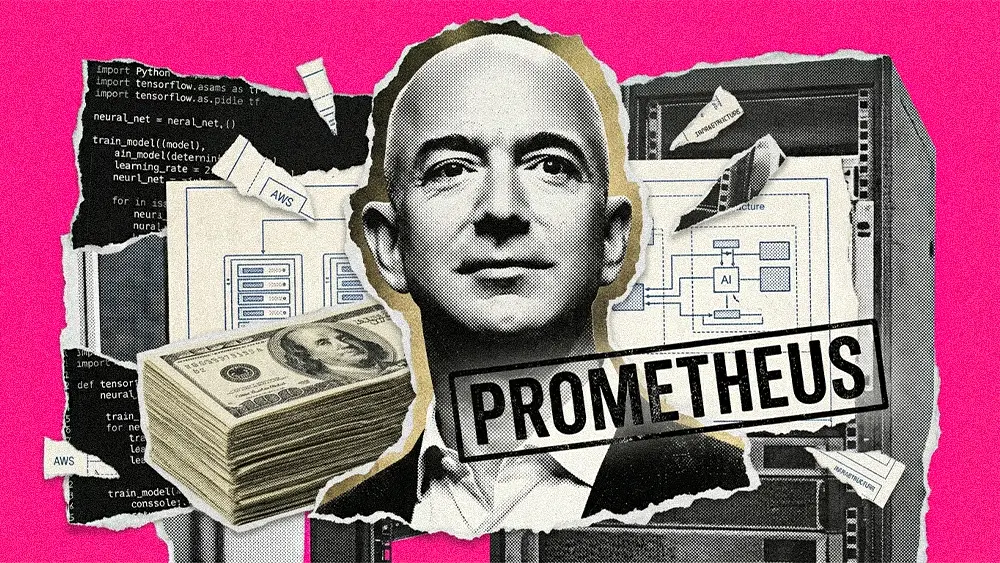
Jeff Bezos sat down with CNBC's David Faber on Thursday and did something he hasn't done since the company launched: he explained what Prometheus actually is. The occasion was a $12 billion Series B that values the company at roughly $41 billion, figures first reported by The Wall Street Journal, seven months after the company launched with $6.2 billion in seed money. Total raised so far, by The Next Web's count, is north of $18 billion. Products shipped: zero.
Start with the investor list. JPMorgan, Goldman Sachs, BlackRock, DST Global and Arch Venture Partners, per Axios, which got the announcement. Plus Bezos himself, who was also the largest backer of the first round. Banks and asset managers of that size don't usually show up this early in a research lab's life. More on why they might be here in a minute.
What it's actually building
The pitch is an "artificial general engineer," a phrase Bezos told CNBC describes "a dream people have had for decades," in citybiz's writeup. Where the big labs trained on internet text, Prometheus wants to train on the physical world. The goal is software that can take something like a jet engine or a drug compound from concept all the way through manufacturing. Target industries, per The Next Web's rundown: aerospace, automotive, computing, advanced manufacturing and drug discovery.
Bezos framed the upside in compression terms during the interview. If a project that would take 100 engineers a decade can instead be done by 10 engineers in a year, the total amount of stuff that gets built goes up, not down. His co-CEO Vik Bajaj, the Verily co-founder and Stanford med school professor running the company alongside him, made a version of the same argument to Axios, saying physical creation today is "nowhere near the pace of human imagination."
Both of them are leaning hard on the more-engineers-not-fewer framing, which tells you they know exactly which question is coming. TechCrunch read the same ambition less charitably: automating large swaths of engineering work outright.
A few concrete details from the interview and the coverage around it. The company has about 150 employees, headquartered in San Francisco with teams in London and Zurich, per GeekWire. RTTNews notes it's recruiting out of OpenAI, DeepMind and Nvidia, and that a big chunk of the new money goes to compute, which it buys from multiple providers, including AWS. Bezos said the rest goes toward building specialized physical-world training data, which doesn't exist the way internet text does. Asked about an IPO, he said it's "too early to think about that." No product timeline, only a vague promise that early rollouts are coming.
One number nobody else seems to have done the math on: $41 billion divided by 150 employees works out to about $273 million of valuation per head.
The part that explains the cap table
Earlier reporting, attributed to the Financial Times, had Bezos separately raising as much as $100 billion for an affiliated vehicle that would buy and operate manufacturing companies. Run the AI through businesses he controls rather than license it out. One source described it as a Berkshire Hathaway for industry.
On CNBC, Bezos confirmed the direction while ducking the number. He said Prometheus may buy parts of companies that could benefit from its technology and help them improve their manufacturing.
If that's the real plan, the model is the engine and the holding company is the business. It also makes the investor roster make sense. JPMorgan and BlackRock don't typically write twelve-figure checks against a research thesis. They write them against cash-flowing assets, and a portfolio of acquired manufacturers retrofitted with proprietary AI is exactly that. Assuming the AI works.
Why this is bigger than the round
This is Bezos's first CEO job since he left Amazon in 2021. He said he started in late 2024 as a founding investor, got pulled in deeper, and decided he couldn't stay on the sidelines. "It is a grind, but it's a good grind," he told Faber, in GeekWire's account of the interview. He's also said he now spends most of his time on AI ventures generally. The Next Web points out his portfolio includes the robotics startups Physical Intelligence and Generalist AI, and he still holds the executive chairman seat at Amazon.
The valuation trajectory is its own story. AI Weekly, citing Bloomberg's tracking, has the round closing at $38 billion in April before finishing at $41 billion in June. A $3 billion markup in seven weeks, on a company with no disclosed revenue, no named customers and no demo.
Bezos also got the obligatory jobs question. He told CNBC he expects the technology to raise productivity and living standards rather than wipe out engineering employment, and said regulation should target specific applications rather than the underlying models.
What we still don't know: whether there are any pilots running, what the first product looks like, the actual size and structure of the acquisition vehicle, and whether "artificial general engineer" is a five-year goal or a fundraising slogan. Faber asked some of this. The answers were mostly "early days."
The honest read is that this is the largest pure trust-me round in AI so far. The counterargument is that the last time Bezos asked markets to fund an unprofitable, capital-hungry machine on faith, it became Amazon. Both things were true on Thursday.